
Introduction
As my project was primarily about increasing millet productivity, I was under the impression that millets were staple food crops which were fairly common in Uttarakhand and that my task was just to render assistance or actions that would further their availability within households. However, the situation was drastically different than what I had presumed. Throughout my travels across the state, whether work related or otherwise, I started to notice that there were no millet dishes served at any restaurant/ Dhaba. I followed up queries with Chinmaya (project coordinator and friend at INHERE – my NGO) about the same. It was then that I realized how millets – which were once a historically significant aspect in the formation of Uttarakhand) – were now a crop facing productive as well as cultural decline.
Now a bit about millets for context; Millets are vital traditional crops in Uttarakhand, especially in hilly, rain fed areas, valued for nutrition, climate resilience, and food security, with finger millet (Ragi/Mandua) and barnyard millet (Jhangora) being prominent for dishes like Mandua ki Roti and Jhangore ki Kheer. There are other varieties such as Kangni, Shama, Kutki, Kodo, Koni, Cheena, and Amaranth but the common ones are Mandua and Jhangora. I too am well versed with just these too – because I’ve had madua roti and jhangora kheer and my project is mostly based around these two. They are quite delicious – especially the kheer. Thus, considering the state’s terrain, millets were chosen for their excellent climate resilience quality and easy potential to quench sustenance requirements.

Types of millets

Mandua ki Roti

Jhangore ki Kheer
Millets and Uttarakhand go hand in hand and it has been so for a very long time. Madua ki roti and jhangore ki kheer were once everyday foods in Kumaon and Garhwal. But tastes have shifted. In my travels through places from Almora, Ranikhet to Sarkot and Chamoli – my eyes came across the varied pahadi cuisines on the menu but never any millet related dish. The food I had from hotels and dhabas were mostly repetitive with wheat, potatoes and white rice – traditional pahadi dishes surfaced occasionally, like bhatt ka dubka, rajma, pathyud and the region’s signature chutneys, but one thing was consistently missing—millets. Thus the decline of millets, in terms of availability as well as culturally, was evident.
Reasons for decline:
I was then curious as to the reasons for its cultural decline. Chinmaya and Abhishek (colleague and friend at INHERE) enlightened me a bit on this.
- Uttarakhand is famous for its out-migration. There are barely any youth left in these parts. The concept and existence of ‘ghost villages’ are rampant. I had seen a few documentaries on these ‘ghost villages’ of Uttarakhand. It is quite heartbreaking when you hear these elders vent out on how the village that held their entire childhood, the place where their children grew up and where their parents passed, slowly turned into a rather post-apocalyptic scene with abandoned buildings, structures and encroached forests all around. Hence without a generation being available within the village/state, how can it preserve a dying millet culture, let alone progress further. Eventually, large farm fields were abandoned as the elderly certainly couldn’t keep at it and so a majority of them turned into forests – good for the environment, bad for preserving millet culture.
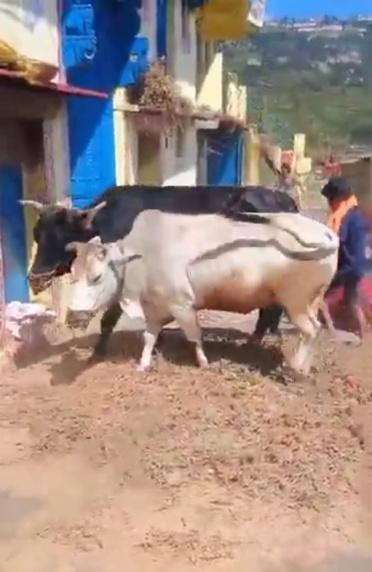
- Tagging along as a factor, and perhaps a rather significant one (according to me anyway), is how labour-intensive millet farming truly is. It takes a total of 15 hours to process 50kg of Mandua and 29 hours for 50kg of Jhangora. By ‘process’ I mean converting them – all the way from harvesting the very crop itself to the last granular/pulverized stage prior to cooking. I arrived at these stats through direct conversations with women farmers within the target villages of my project. The crop is threshed using traditional cow-rotation method where the cattle are made to walk in circles on top of the gathered crops. After threshing, it is de-husked by beating/thrashing by hand using a wooden mallet-like object. This part is rather physically demanding. The next generation certainly doesn’t have such man hours or physical will to spare. The arrival/establishment of processing machinery could drastically reduce such hours – which are a major interventional aspect of my project. However, it’s safe to conclude that the labour intensity aspect definitely contributes to the overall decline.
- Contributing to the turmoil is the destruction of these crops by wild animals. The effort put in a whole agricultural year can go down the drain in a single night. This adds immense discouragement to pursue farming as a whole. Children also watch their parents suffer through that and so it’s not surprising to watch them grow disinterested and apathetic towards farming in general and millet farming in particular. This disinterest also leads to loss of valuable traditional knowledge that should have ideally been passed down.
- Socio-economic factors also played a considerable role; Overtime as affluent sections of the society established themselves, millets were considered as a ‘poor man/labourers’ food. This notion had effectively removed its consumption from the plates of the rich and their children. Other children didn’t want to be looked down on for having a millet based diet on a daily basis and so it can be said that social norms gradually killed off millet consumption.
- Another reason that led to the steady decline was the Green revolution; which popularized high-yielding wheat and rice. While these boosted food production, they also depleted soils, strained groundwater, and sidelined traditional grains. Overtime coarse grains such as millets came to be seen as inferior, even though they are more nutritious. Even government policies contributed to the study decline; the PDS system distributed subsidized wheat and rice, making them the staple for millions and thereby discouraged farmers from growing millets. The economic and sustenance benefits gradually solidified over time and resulted in reduced millet usage.
Cow rotation method

Beating the crop with sticks/mallets. (Not an exact image but it’s almost the very same.)

Cow rotation method
Reviving millets in the hills:
When it comes to millet revival, one could say a lot of interventions from various agencies are definitely happening; however, the effects seem to occur at a very sluggish pace. The United Nations declared 2023 as the International Year of Millets, following India’s proposal, to highlight the importance of millets in food security, nutrition, climate resilience, and sustainable agriculture. Along with this, the Government of India also supplemented in their own way through a policy led initiative – ‘Millet Revival Project’. The UN initiative aimed to increase global awareness about the nutritional and ecological benefits of millets and to promote sustainable production as well as consumption. The Indian government aided with a few great initiatives such as integrating millets within the PDS (Public Distribution System) and school meal programs. In Uttarakhand, the state government has increased the MSP (Minimum Support Price) for such crops and also provides processing machinery at a subsidized rate (at a whopping 80%). INHERE had also availed that subsidy to establish the processing units as part of our project. We plan to establish five processing units at two villages within Uttarakhand which will benefit around 365 farmers. These units will have the necessary machinery to effectively process the millets to its last edible state, thus saving a huge amount of time spent in manual processing, and eventually help to venture out into further value addition interventions.
Reviving millets in Uttarakhand will require more than awareness about their health benefits and climate resiliency. Farmers need both a market and a taste-driven reason to grow them. Hopefully interventions and experiments with millet based snacks such as mixtures, noodles, cookies could mitigate the damage and help people rediscover millets in new fun forms. In this manner, the grains may find their way back to plates, kitchens, and fields.