

Despite the seemingly accusatory title, the underlying sentiment is one of curiosity, a key driver in effective problem-solving.
The fact that problems exist is not exactly a groundbreaking discovery. What many people miss is that randomly asking questions to find the answer takes us nowhere. A problem solver’s search must begin with the quest for the right question.
Professionals in the development sector must realise that the sector’s success is measured by the value it generates, both in the short and long term. However, a fundamental aspect often overlooked is identifying the right problem. When we fail to address the right issues, we end up with solutions like constructing check dams in unsuitable areas or providing subsidies to large landowners.
Hence, identifying and defining the problem is fundamental for problem-solving. However, it isn’t easy to describe this ‘problem’ since several instances prevent us from recognising the right issue.
- A commonly made mistake is an excessive reliance on experience and gut feeling to make quick judgements under pressure. One should never have a solution in mind and then attempt to force fit a problem that can be solved. For any individual beginning an initiative in the development sector, a healthy assumption to make at the beginning of any project is that they know nothing about the problem. This ensures that one remains open-minded, effectively incorporates feedback about local situations, and possesses alternative avenues to identify root causes and solutions. The best problem solvers regularly question their gut feelings and slow down frequently to evaluate.
- Another misstep is the distinction between specificity and generality of the problem. Many individuals commit the error of over-commitment, which means they invest too much time and resources in earnest attempts to solve larger problems when a more efficient approach would be to focus on specific avenues. On the other hand, being too focused might mean that we miss out on external factors that could significantly impact the problems. Maintaining a balanced view is beneficial. A safe approach is to broaden the initial scope of the problem and narrow it down after evaluating existing resources, limitations, and the scope of potential solutions.
Overcoming hurdles such as the two mentioned above enables us to look in the right direction. Once we evaluate the broad scope of what we are trying to solve, we can narrow down, prioritise key aspects, define the problem and test our problem definition.
The problem definition or problem statement must fulfil 5 aspects to be considered ideal. The 5 are:
- S – The problem statement must possess a specific scope.
- M – The impact of potential solutions to the problem must be measurable. (Performance must be evaluated utilising measurable indicators)
- A – The problem statement must be of a nature that can be acted upon.
- R – The problem statement must be relevant for all stakeholders involved and must align them towards the same objective.
- T – The problem statement must possess a time interval within which it can be solved.

The following questions can help ensure that we think through the most critical elements of the problem statement:
- What is the problem we are trying to solve? (The Problem Statement)
- What is the context of the problem?
- What is the scope of the problem and potential solutions?
- What are the constraints within which the problem must be solved?
- Who are the stakeholders involved, and how do they align with the problem?
- How can the success of the solutions to the problem statement be measured?
Reflection is always key. Asking powerful questions and evaluating enables us to refine the problem statement.
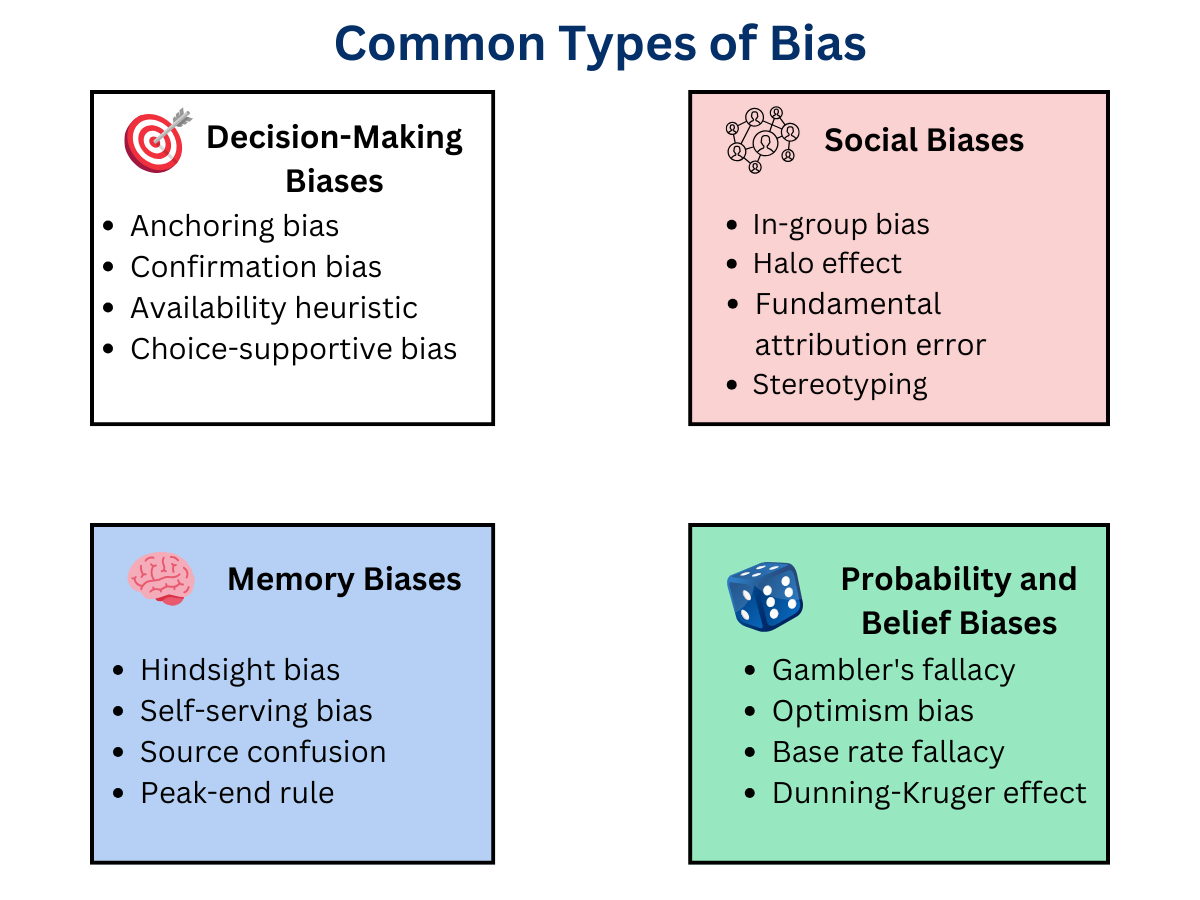
To regulate our ‘gut feel’, problem solvers must regularly employ debiasing techniques. These techniques help ensure that defining, structuring, analysing work, and solving the problem take place without bias and that maximum benefit is extracted from proposed solutions. Examples of debiasing techniques include considering alternative perspectives, seeking feedback from diverse sources, and consciously challenging your initial assumptions. A website link is provided below this post to a website that lists several common cognitive biases which consciously or unconsciously hinder our judgement and decision-making.
While it may seem daunting to devote such a high level of attention to a seemingly simple activity, clarity in defining the problem will ensure that we can arrive at a practical solution much quicker, and the probability of success for that solution will be significantly higher if we define the problem correctly.
Hence, never forget to ask, ‘What’s your problem?’
Types of Bias (Image Source and Biases List): https://www.explorepsychology.com/types-of-bias/
SMART Image Source: https://www.leanjax.org/blog/2022/2/15/kramer-and-newman-get-smart-xjmmt